Judging: Advance Planning, Firm Commitments & Loving Your Work
Understanding your drive for closure, structured goals, and discovering joyful presence in your responsibilities.
Why I Love · The Practice of Love
Judging Is Love of Your Work
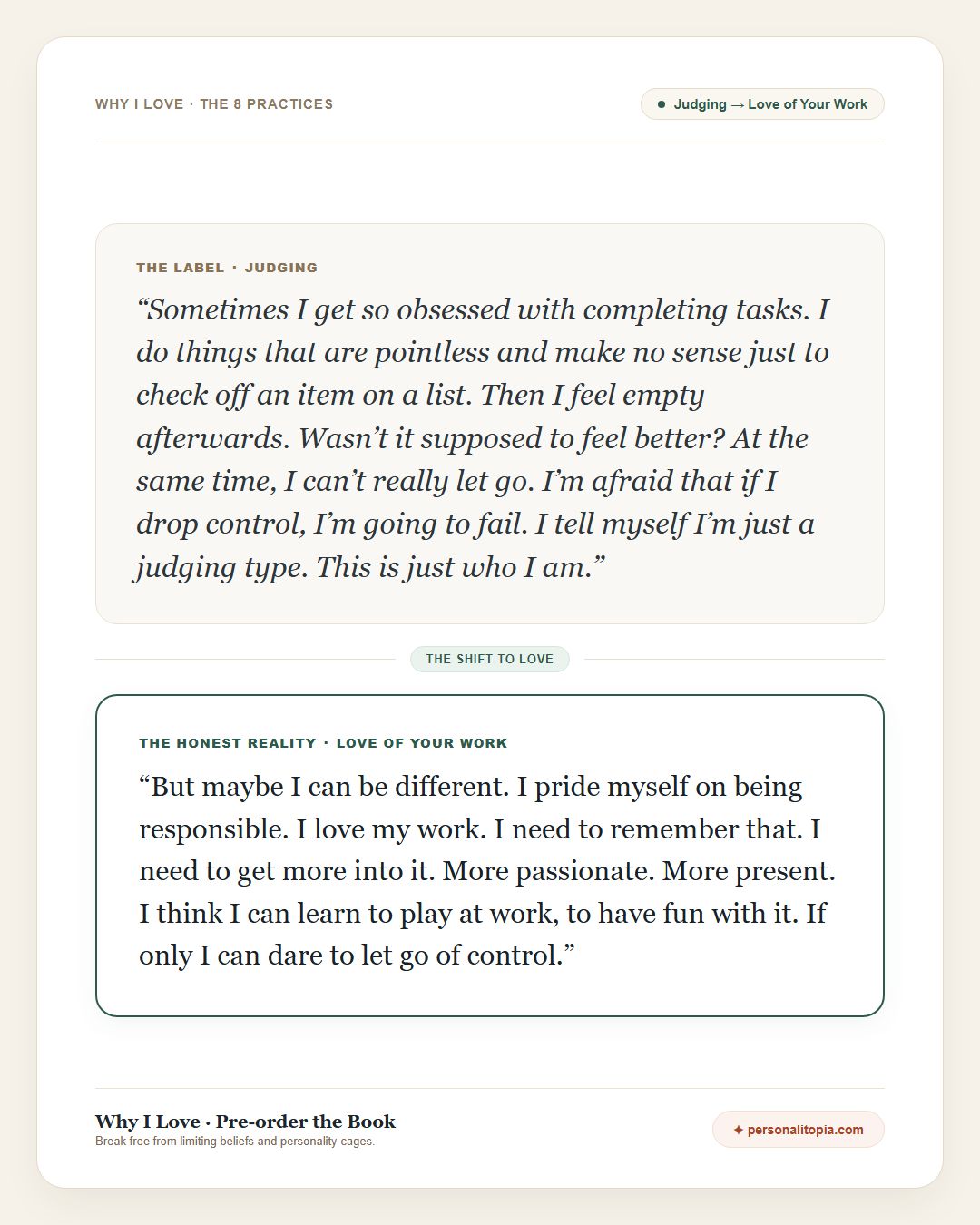
Sometimes I get so obsessed with completing tasks. I do things that are pointless and make no sense just to check off an item on a list. Then I feel empty afterwards. Wasn’t it supposed to feel better? At the same time, I can’t really let go. I’m afraid that if I drop control, I’m going to fail. I tell myself I’m just a judging type. This is just who I am.
But maybe I can be different. I pride myself on being responsible. I love my work. I need to remember that. I need to get more into it. More passionate. More present. I think I can learn to play at work, to have fun with it. If only I can dare to let go of control.
What It Means
Judging is your drive for structure, closure, deliberate planning, and decisive follow-through. When this drive is dominated by anxiety, it easily turns into compulsive control: you obsess over checking off items on a checklist, feel empty even after completing tasks, and fear that letting your guard down for a moment will lead to total chaos. But judging, at its best, is the practice of love of your work.
“Judging is learning to love your work—releasing the grip of compulsive control so you can bring presence, passion, and play to your daily responsibilities.”
When you practice judging with love and presence, work stops being an anxious chore. You take pride in being reliable, but you do it with joy. You create clean systems that liberate people rather than trap them. You make firm commitments, establish realistic milestones, and bring projects across the finish line with craftsmanship, steady focus, and satisfaction.
When this drive becomes unbalanced, you can get impatient with necessary pivots, treat people as tasks on a to-do list, or struggle to relax even when work is done. Loving your work means daring to let go of rigid control, trusting the process, and finding pleasure in the craft itself.
Core Traits & Preferences
Judging Match
Check off statements above to calculate your match score.
Your Personality in Context
At Work
In professional roles, your judging orientation provides reliable momentum, strategic foresight, and execution. You set clear expectations, manage timelines, and build dependable workflows that keep organizations functioning at their best.
In Relationships
In your personal relationships, you offer stability, clear communication, and follow-through. Your partner and friends know that when you make a plan, they can count on you to be there, fully prepared and present.
In Groups
In group settings, you help translate vague hopes into concrete action plans. You clarify responsibilities, establish timelines, and ensure that everyone knows what the next steps are.
On Your Own
In your private time, you feel centered when your space is orderly and your obligations are handled. Giving yourself deliberate, unstructured time allows you to truly recharge without feeling guilty.
Four Cognitive Function Thought Patterns
Judging manifests across the cognitive functions in four distinct ways.
1. Organizing logical systems (Extraverted Thinking)
You establish measurable goals, optimize procedures, and build effective logistical frameworks to deliver reliable real-world outcomes.
“I organize resources and workflows to turn practical goals into reality.”
Learn more about Extraverted Thinking
2. Organizing communal values (Extraverted Feeling)
You coordinate group events, cultivate social harmony, and take responsibility for the emotional well-being and inclusion of the community.
“I coordinate shared efforts to make sure everyone is cared for and supported.”
Learn more about Extraverted Feeling
3. Deliberate conceptual roadmaps (Intuitive Judging)
You combine big-picture vision with structured execution, charting clear strategic trajectories that turn long-term ideas into reality.
“I map out steady milestones to guide our journey toward a meaningful horizon.”
Learn more about Intuitive Judging
4. Practical stewardship (Sensing Judging)
You maintain proven traditions, uphold daily duties, and protect the foundational routines that keep community and family life steady.
“I take faithful care of our commitments, providing a stable foundation everyone can trust.”
Learn more about Sensing Judging
Journal Prompt
Where have you been doing tasks mechanically out of anxious control, and how can you invite more passion, presence, and play into your work today?
Loading discussion…