Results from my survey sent out to 2,000 people show a majority of you believe in personality types or see it as a useful tool. Let’s talk about that!
Yesterday, I ran a poll with all of you to find out what you think about personality types and personality psychology today! Thank you to everyone who answered. It was really interesting to hear your thoughts and read your comments.
I was curious to see that 70% of my audience believes in personality types, and that more than 53% are primarily interested in the MBTI.
This makes sense. I have a decade-long history of speaking about the MBTI, and the MBTI is the most popular personality tool in the world. That said, I think if I did a deeper poll, I think many would say they prefer the original Jungian theory of Cognitive Functions over the classic theory of MBTI Personality Types.
Most people start by studying personality and eventually become more interested in cognition. While the MBTI focuses on your personality, or how you appear to the world, cognition is psychologist Carl Jung’s attempt to study what people are like on the inside. If you look at the 16 personalities for a bit, you eventually start to feel that categorizing people into just sixteen types is slightly superficial. Cognition is about what happens inside you – your thoughts, emotions, sensations, and intuitions— most of the things that nobody around you can see, yet they are there. Even if they can’t be measured.
After you meet 1-3 people with the same type, you start noticing that though they have some similarities, they also have differences. But why do they have differences? This leads you to consider a person’s cognitive development and health. I’ve been on a journey here, moving from horizontal to vertical typology. Instead of studying people based on their personalities, I became increasingly fascinated by health, personal development, and how we can expand our consciousness.
I can still see and group people into types, but like Carl Jung in the later part of his life, I came to see personality types as less and less important than what shapes and makes a person. When I started studying the MBTI, I wanted to know which personality type best fit me. The final puzzle piece came when I started studying morality, values, and virtue ethics, and ultimately asked myself: What kind of person do I want to be? And what kind of life do I want to live? That question forced me to reevaluate my entire life and make some very different choices.
49% believe your personality is primarily shaped by your genetics, while 35% disagree. And, somewhat contradictorily, 73% say your personality is primarily shaped by your childhood and environment.
I think what happened here is that people are trying to say both: they believe that genetics and childhood play a role, but they’re confused or uncertain about the degree and how much it matters.
72% believe your personality can change after you become an adult, though a commenter clarified that they believe that your personality can change, while your personality type stays the same.
Essentially, this suggests that people believe that while your personality can change to a significant degree, you will still remain within a certain “group” for the rest of your life. Your personality type or grouping solidifies as a child, and while you’ll make changes and improvements over the course of your life, you’ll stay within this personality type cluster.
This shows something important: People believe that personality type does not explain everything about you or who you are, and that there is a lot about you, hobbies, values, opinions, that exists outside of your personality type. People believe there is wiggle room. Your personality type is not a tight box, but rather a bigger room, with room to move around.
To me, biology shows that no category is simple, and while we can rely on categories, like, for example, biological sex, there are a million variations within a gender. That’s why I chose to focus most of my channel on exploring subtypes and variations within a personality. I chose to use the MBTI, and its simple categories as a tool to simplify and explain complex phenomena. I would also like to add that human beings are at least 50% similar to one another, meaning we can all agree and relate to every person we meet; we have more things in common than we do differences. So be human with people first, and you’ll already have a lot to talk about.
43% of my commenters said they have made life decisions based on their personality type; for example, they may have chosen to primarily date a certain type or pursue a certain career or study as a result of their personality test results.
This is my big fear — that people use personality psychology as a map for how to live their lives. It’s also the premise of the MBTI, created by Isabel Briggs Myers, to help companies find the right fit to hire. The MBTI is primarily used for career advice and helps inform recruiters and managers on whom to hire, promote, and fire. The MBTI is secondarily used for dating and relationships, and only thirdly for personal growth. I don’t think you should ask yourself, “What should my personality type do”? Ultimately, you might even be mistyped for all you know! You should trust your inner compass and ask yourself: “What is it that I want to do?”
Using the MBTI to make life choices – who to date – and to decide who deserves a promotion, that’s scary to me – because I think it should be completely flipped. The MBTI is far more useful as a tool for helping you decide what kind of person you want to be. It shouldn’t be used as a static tool to organize people into neat boxes. It should help you self-reflect on your values, motivations, and life, and make choices about how you want to live. You might be an introvert today – but how can you live a good life? What would allow you to have a good life? Are you happy with how introverted you are today? And how do you want to relate to being an introvert?
What is the goal of personality psychology? I see two common takes:
Some believe we should live our lives in line with our core preferences; for example, an introvert might want to live a more introverted life, and an extrovert, a more extroverted one, and the goal would then be to align our lifestyle with our personality.
Others believe the goal is to transcend or overcome your personality type’s natural biases, becoming a more balanced person. For example, an introvert should aim to integrate and develop their extroverted side, and an extrovert should learn to reclaim their introverted shadow.
In my poll, I worded the questions poorly, leading people to overwhelmingly vote (73%) that the goal should become more balanced.
I don’t personally believe that being a certain personality type or fitting into a certain personality type is your goal. You’re ultimately a unique person. I also don’t think you need to become balanced – it depends on what your life calls for.
The question is: Are you a good person?
Let me rephrase that: Are you living a life in accordance with your personal values?
And what does the world need from you? What do your friends, your colleagues, and family need? And what is it you are uniquely fit to provide for them?
Are you living a courageous life? Are you living a benevolent life? Are you living a creative life? What are your values, and how well are you able to practice and live your values in your work, your relationships, and your day-to-day? If you fall in love, and you meet somebody who challenges you, or who has different preferences from you, how will you respond to that?
For example, if you identify as an introvert but want to live a free and brave life, would you let your introversion hold you back? Or would you go out and seize life by the horns, even if it’s scary and sometimes overwhelming?
The trap is that we let our personality type become a prison. We tell ourselves we have to be or live a certain way because of our personality, even though living that way might make us miserable, hurt other people, and make the world a worse place. We’re ultimately still tasked with aligning our personal values with those of others.
Personality types are just a tool, but a useful one
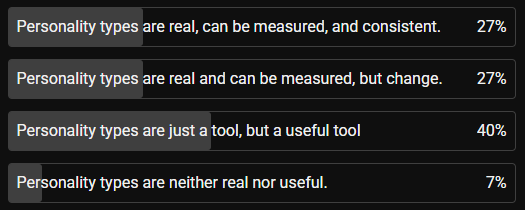
While some people (27%) believe personality types are objectively real, measurable, and consistent over time, 27% see personality types as changeable concepts that can change over the course of your life, suggesting people are torn on the topic. And people are 50-50 on whether personality types are real. Some see it just as a tool. But we can all agree that personality types are a useful tool when used correctly. How do you use personality types, and what is your goal with them?
Carl Jung: “Personality types mean nothing, nothing at all; they are merely the instrumentarium to explain a husband to a wife, or vice versa.”
See the results and cast your vote here.
Share

Loading discussion…