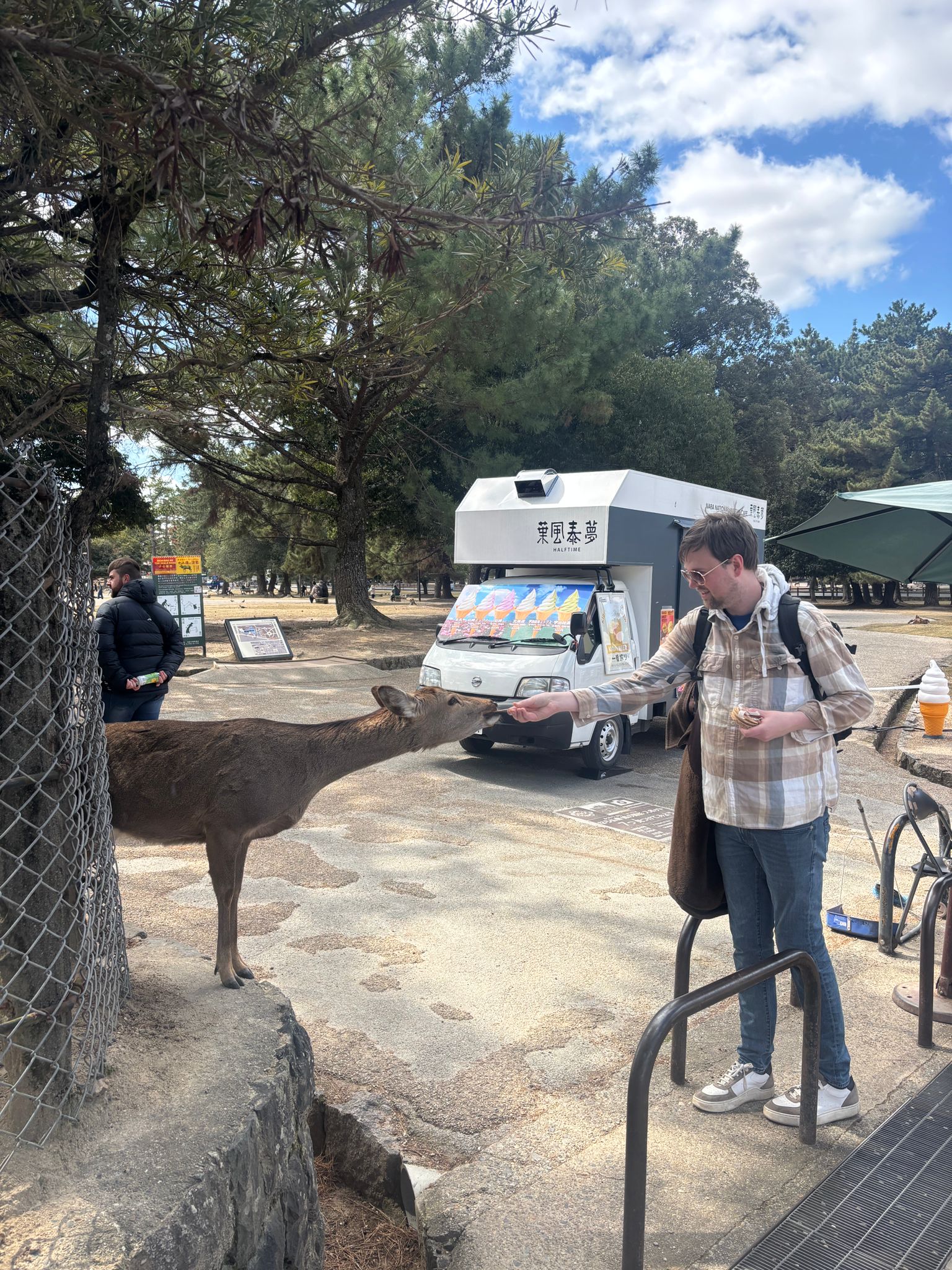
I am in Nara Park, standing face to face with a deer. He is not afraid. He bows once, twice, three times. I bow back. Then I give him a cookie. Next to me, a German tourist talks about how what I am doing is animal abuse. I speak a bit of German, so I can pick up the gist. Deer should be protected from humans, he says, and these crackers can’t be healthy for them. I think about what he says for a moment. Could that be true? Why have the Japanese evolved to let their deer roam free? These are interesting questions on their own, but I want to focus on another. When traveling to a country, so easily, I get lost in eyes of judgment. I will judge a country by how they treat their poor and homeless. I will judge a country based on their animal ethics. I will judge a country based on their laws and cultural practices. This is true in Japan, and it is true in Barcelona, and it is true in the US. What if my eyes of judgment are limiting me from empathy and respect?
Developing Universal Empathy
I could spend every single minute of my day complaining. About the food. About the streets. About the people. I could find flaws in everything, if I wanted to; my brain is happy to help. But something makes me pause. A thought: What if instead of studying this country or culture from my own, Swedish eyes, what if I saw the culture from its own eyes? What if I allowed myself to develop universal empathy? What if instead of thinking of what is wrong with a country and its cultural practices, I asked myself: How could this be right, if I was born in Japan, and if I had the same history and background as a Japanese person?
This universal empathy frees me to understand and observe and truly keep an open mind when traveling. It allows me to truly bond with and immerse myself with another culture. It allows me to truly keep an open mind when traveling.
The Defensive Wall of Judgment
Judgment makes me close my eyes, makes me look away, makes me stop paying attention. It is a defensive reaction in the brain to anything new. When in a new situation, instead of learning from it, our brain can choose to put its walls up, to say “This is wrong.” It may even convince us that it is morally right to judge. That our judgment will somehow help the deer of Nara, that it will make us a better person than they are. It justifies me in keeping my emotional distance from these people, from their traditions, and from their beliefs. After all, I didn’t grow up with the 1300-year-old belief of Nara people – I never heard the story of the white deer. I never grew up with the idea of deer as holy animals or as national treasures. I grew up with the idea of deer as things you eat or wear. As if that is somehow better, or more morally righteous?
The truth is, I don’t understand, and I should always assume that I don’t understand. I should assume that I don’t have all the facts. I am a visitor here – not an expert. What right do I have to tell the Japanese people what to do, and what not to do? How can I come in as an outside observer and tell other people how they should live? What they should eat? What they should wear?
I know people that spend their entire lives trapped in judgment. Everyone is evil. Everything is problematic. If something can be interpreted in a negative light, it should be seen in a negative way. They can find ways to pick apart the kindest of gestures, the sweetest, and most innocent of acts. There are also plenty of forces out there that exploit our tendency towards judgment. Movies, documentaries, TV shows, and news channels, pulling on your heartstrings, showing crimes happening on the other side of the world, making you angry, tense, stiff. It blackens your eyes, makes you furrow your nose, makes you tense up, makes you afraid of the world. What if instead it made you eager to understand, to ask questions?
Language as a Bridge
In the United States, most people only speak one language. I think it makes it harder for them to understand other cultures. Perhaps that is one reason why they spend so much time locked in war. They have barely even finished bombing one country until they find a new dictator they need to kill or a new people to rescue in return for oil.
Learning to speak in another language is one of the best ways to practice this universal empathy, the ability to see with, and from, another person’s eyes, through another language. Trying to learn a language, though, brings up the very insecurities we try to fight. As I would practice Dutch, I would so often tell myself reasons to stop practicing.
Do I really want to stay in this country? Do I really like these people? I realize now that it was my brain trying to protect me from caring about other people. Now, when I hear Dutch, I immediately spark up, and feel happier. I have grown to care – and have empathy – for these people. And it has made me a more open-minded person as a result.
I was willing to challenge my own fears and insecurities, willing to love, willing to become attached to something. Because that is what it is all about. We don’t worry that we will be hurt by a culture. We worry that we will start to love it. And our brain does everything to come up with rational reasons not to. How can I love a country that eats too much fried food? And does this somehow mean that I accept their practice of “Zwarte Piet”? I don’t think so. I think, even if you disagree with many things, you should make an effort to understand them. If you are prepared to bomb a country to “save the people” in that country, you should be prepared to learn the language of that country, the traditions of that country. Not because you agree with them, but because bridges can only be built with understanding and awareness.
A Time and Place for Judgment
The older I become, the more I gravitate towards the idea of universal empathy and respect. There is an author named John that speaks of the word “Sonder”. Sonder is a word that captures the emotional depth hidden in every person. I could so easily label other people ast stupid, evil, or simple, but I am forced to reconcile that every person I meet has deep, unknown motives, beyond my comprehension. I must assume that every person is a main character in their own lives. I must assume that they themselves believe themselves to have good intentions. I can’t see people as if they are this faceless evil, doing evil deeds, for the sake of evil reasons. I must assume that they have good reasons for what they do, even if these reasons are wrong from my own perspective.
Instead of judging other people, I should understand them as complex characters, with unique, unknown backstories. Instead of thinking I know better than other people, I should assume that they know what is best for themselves, or that, at least, they are on the path to discovering it, and that they know the way better than I do.
There is a time and place for judgment.
I am not saying that you can’t have opinions or preferences for yourself, but that you must recognize that these are preferences that you have for yourself. Instead of saying that you are against how the Japanese treat their deer, you should say, that from your own point of view, or your own country, the idea of letting deer roam wild is strange, or feels wrong, to you, personally. And when you come home from your travels, you should ask yourself, how does your country treat deer? How should your own country treat their deer? How can you, personally, treat wildlife with respect, when you travel? This is how travel can inspire reflection and empower you to improve your own life. I have friends that spend their entire lives complaining about other people, on the other side of the planet, speaking of how bad they are, how evil, how misguided, while completely blind to what is happening in their own countries, in their own lives, and their own relationships. Things like “Trash TV” can give us a false sense of moral superiority, can blind us to our own flaws, and make us feel better than others. It also makes us walk around with anger in our throats, instead of love in our hearts.
I am not saying you should become a moral relativist.
Instead, what I am saying is:
Let morality develop in its own time and place.
You are allowed to and encouraged to have and develop your own sense of morals in your own home, your own life. Morals help us navigate life and complex matters like right and wrong. I believe we should always question our morality though. We should always ask ourselves how we can deepen and nuance our beliefs. I am not saying to get rid of them – I am saying to let them evolve.
Think Global, Act Local
I think, if you find yourself having a strong reaction to another culture, religion, or ethnic group, and their beliefs, practices, diets, or lifestyles, instead of questioning them — question how these problems show up in your own life, and let it inspire how you live, in your own home. Instead of asking how Muslims treat women, ask yourself how you, and your culture treat women, and work from where you are. Think global, act local. Your job is not to become an emissary or teacher, come to travel to, and tell other people how to live. Your life task, as Alfred Adler would put it, is to live your own life, and to practice your beliefs, in your own home, your own work, and your own relationships.
The Complexity of Compassion
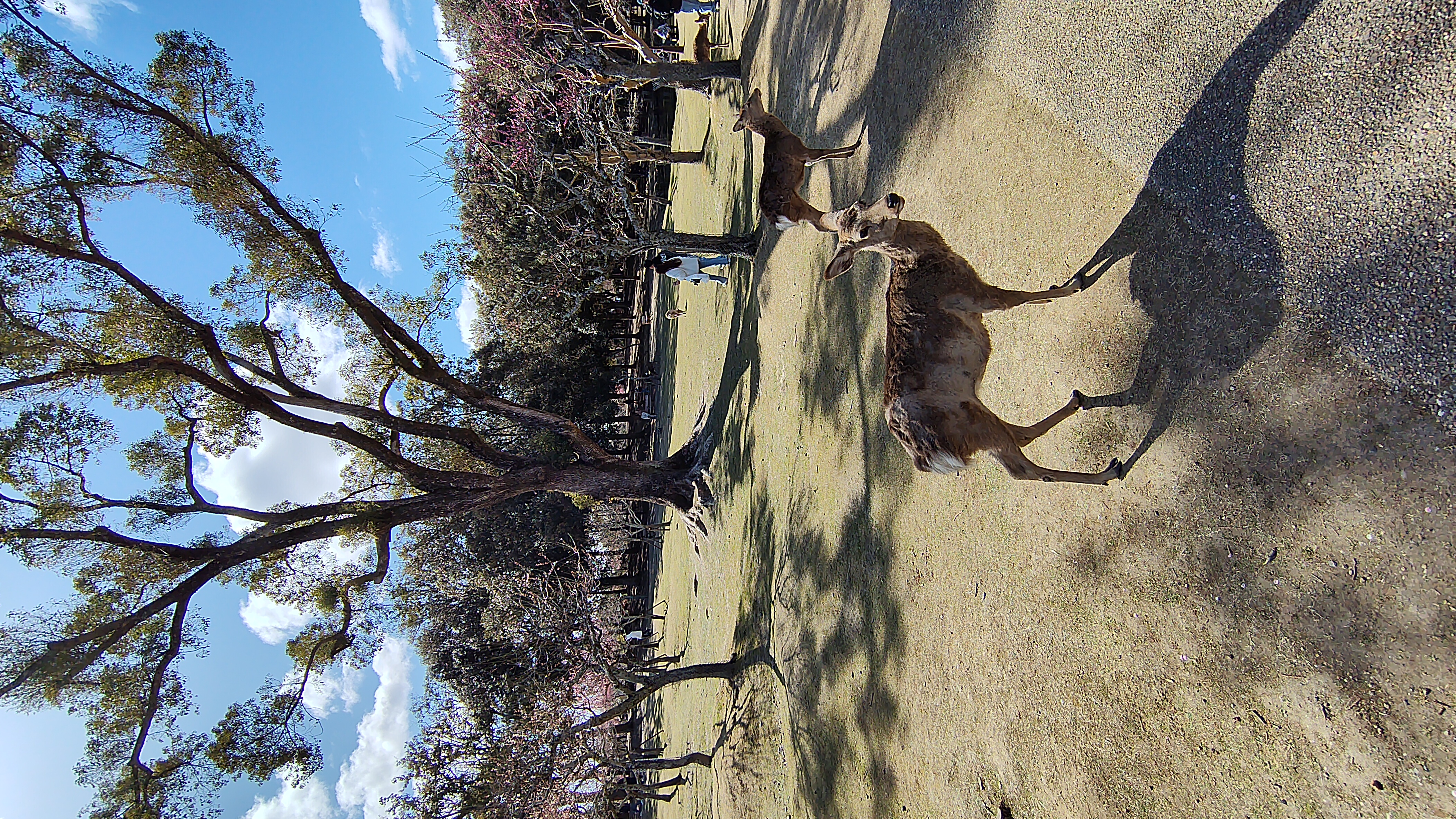
I am brought back again to the image of deer and humans interacting in the park. These relationships are complicated. Love is complicated. There are misunderstandings. Accidents. Problems. The option is to separate us, to put the deer in the forests, and to enclose the humans in the cities, where they won’t meet, won’t hurt each other, won’t see each other. Is it safer? Maybe. But what does it do with humans’ capacity to empathize with something else than their own species? I realize then that that German tourist might have been on to something. In that moment, in the sight of that deer, the German felt empathy, compassion, for the deer. And it was that compassion that made him fall into judgment. In Nara, he saw a deer try to choke down a plastic bag of cookies, and he felt angry. In his own home town, on his own hike, he might carelessly leave plastic bags of food in the forest, unaware of how it might affect the wildlife in his local town. Without the experience in Nara, he might never even have thought to care for a deer, or its feelings. And isn’t that just another way tourism can broaden our horizons and show us things we might otherwise miss? At least I hope that is the lesson he drew from it. I hope he didn’t leave Japan feeling like he was somehow a better person than the Japanese. I hope he left Japan thinking of how he could become a better person, in his own life.
The Promise of Travel
This is also the promise of travel. The promise of inspiring us in becoming better people. In teaching us different ways to live, love, and laugh. Travel can open our eyes and inspire our own lives. It can enrich our experiences, teach us new things, and introduce us to new things that make sense. But only if we notice the moment that judgment sets in, and instead, allow ourselves to open our eyes, to observe, and to see, and to understand, and ask questions. To let ourselves be taught, instead of trying to teach. When we travel, we don’t need to become like the country that we travel to, but we can let ourselves be impressed, and think of how we want to bring these practices and ideas back to our own homes.
Travel has taught me so much. Japan has already taught me a lot – about finding magic and meaning in everyday places, in work, in forests, and in mountains. The Japanese have taught me gratitude, and that is not a lesson I will soon forget. I look forward to practicing gratitude in Sweden, the Swedish way, when I am back at home again. And I will remember these experiences for the rest of my life. What is something that travel has tuaght you?
Share

Loading discussion…