Take my new flow personality test and find what it is that puts you in a state of flow, what flow is to you, and how you can find it at work.
I remember a few years back. My boss calls me on Teams, it’s 7 in the evening. Erik, customers are reporting that a web form is down. Can you look? My body becomes tense. I feel angry. Why me? I think to myself. But I boot up my PC, tell my girlfriend I need to jump in and help with something. After another hour, I still have no clue why it’s not working, and the other team managing this is not available to answer any questions. I worry that I’ve accidentally messed something up, and I try to recall everything I did in the last few days, but nothing comes up. What could I have done wrong? The answer was nothing.
Two hours pass, and I feel nervous and sweaty. My girlfriend is frustrated because she wanted us to play board games this evening. I worry about being fired or being yelled at. At 9 pm, I tell my boss, ”Sorry, I can’t find a solution tonight. I’ve looked everywhere, and everything looks normal on my end. I’m going to have to look with the other team tomorrow.” The next day? I found out that a server on their side had gone down and needed to be rebooted. My boss, frustrated, told me I should have just told him immediately instead of wasting his time if I couldn’t do it in the first place.
This is a story about how stress can show up at work. We close up. We rush ourselves. We don’t think about the bigger picture. I was trying to solve a problem that was never mine to solve in the first place.

But what are we like when we enter into a state of flow? How do you feel when you are in a flow state? And why do so many people think of work as something that gets them out of their flow?
And what gets you out of flow?
In flow, I feel a complete state of freedom, like anything is possible, and that all doors are open to me. I get to choose when and how I do my work. My boss doesn’t micromanage me or tell me what to do or when to do it. I trust myself, and my colleagues trust me. I think that’s why we often think of work as opposed to flow. We see work as the place “we’re forced to go to” and “which we only do because we’re paid,” but to me, you can absolutely find freedom in the constraints and challenges of work. But it requires you to challenge the reason why you show up at work.
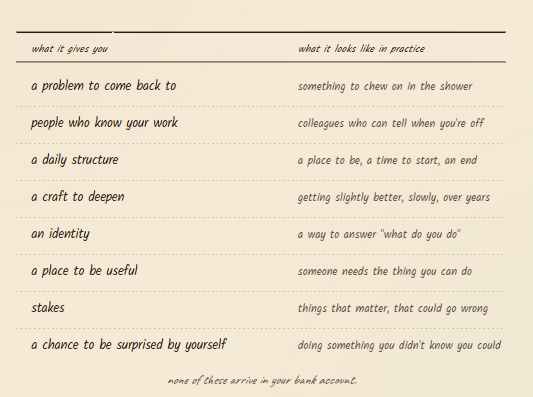
Here’s my question for you: If you weren’t paid to do what you currently do as a job, what would make you still do it? Try to journal about what your work gives you, besides cash. It might feel at first as if nothing comes to mind. But I challenge you: there are things you can find at work that are beautiful, meaningful, and important if you let them feel that way. What are those things?
Here is some inspiration to help you answer:
Why we fail to find flow at work
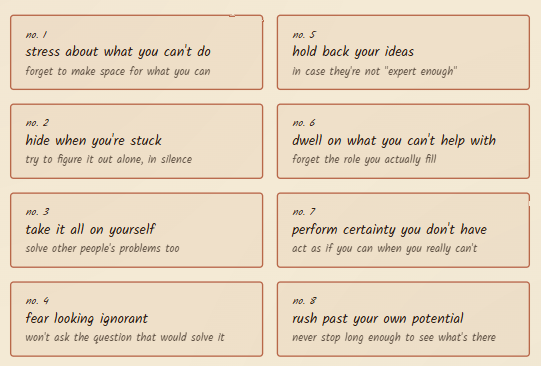
I think the biggest reason we don’t feel flow at work is that we don’t know what our capabilities and our potential are. We stress about what we can’t do and forget to make time for what we can. We fail to be honest and transparent with our colleagues when we feel stuck or lost. We try to take on everything by ourselves. We feel insecure when we don’t know the answer to a question, rather than honestly admitting our own ignorance. We fear speaking up and sharing our ideas, and hold back our power because we fear not being seen as “experts”. We fail to recognize our role or how we can help, and we dwell on how we can’t.
For example, you might be a junior at your job, and worse than everyone else at every task. But you can still help your team. How? By asking good questions. Good questions help your team learn and rethink things that they might take for granted. You can also help by making them simplify complex, time-consuming processes, making things easier for everyone else, not just you.
You can help by making mistakes and forcing them to improve their routines, implement better processes, and build diagnostics, troubleshooting, and peer review processes. This is the value you bring – even by knowing nothing. But what value do you bring as a junior if you avoid asking questions, trying to appear like an expert? If you act as if you can, when you really can’t?
When was the last time that you were genuinely in flow at work?
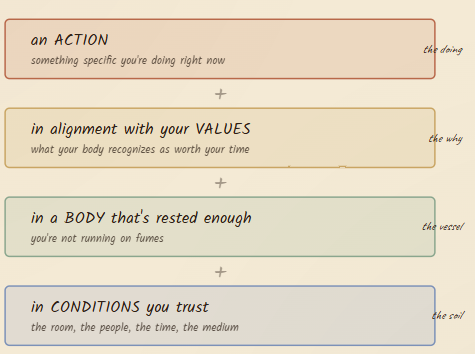
I was in a flow state yesterday – despite feeling sick and tired from my trip, and despite the fact that I had more than seventy open tasks on my to-do list. Because I was letting myself focus on what was really important to my company. I let myself choose what really mattered to my colleagues, our customers, and to myself. What is it that is most likely to put you in a flow state?
Let’s talk about the practical parts of flow.
The Medium
What type of medium(s) help you enter into a flow state? Think:
Writing on a notepad vs on the computer
Talking into your phone
Discussing with a friend
Drawing on a whiteboard
Sketching designs
The room
Being alone in a quiet space vs. in a social cubicle environment?
Ambient sounds and background noise? A podcast on in the background?
An office chair? Standing next to the desk? A balance ball?
Working from outside?
On the couch or on the floor?
Where do you sit in the room? In the corner? In the back? Or in front?
The habits
How often do you need breaks? Many short breaks or a few long breaks?
What do you do when you take a break? Exercise? Walk? Socialize? Read? Draw? Listen to a podcast? Which ones give you energy? Which takes energy?
How do you make sure you show up 100% energized at work? And 100% relaxed outside of work?
Do you talk with your colleagues before you start working? Or dive straight in?
The approach
Do you stand up straight? Are your legs and shoulders wide or curled up?
Do you speak with a loud or quiet voice?
Do you talk quickly or slowly?
Do you smile or have a neutral expression?
I hope this post taught you more about flow and work, and how you can find more flow at work.
Share

Loading discussion…