It’s said that your personality is equally made up by your genetics and your environment. But is that really true?
A common interpretation of the nature-nurture debate is that one part of your personality is constituted by your genetics, as hard-wired traits that you can’t change. The other half comprises environmental traits, which are flexible and context-dependent. In this view, you might say that your tendency towards curiosity is hard-wired, and that your tendency to be polite is a social construct.
We’re far from the “tabula rasa” days when we thought of children as white pieces of parchment, ready to be filled in by their parents and teachers. We used to believe that children could be engineered through Bill Skinner style Behaviouralism. Now we know that it is not possible. The mainstream view used to think that self-development was a matter of “will-power” character, or self-discipline, and that you could overcome your genes through sheer willpower. Now we know, it’s not that simple.
“We do not come into the world with a bundle of fixed, stable traits that determine who we become. We develop in continuous interactions with our social and biological environments.”
A geneticist would tell you that there is no gene for kindness, no fixed trait waiting to be “flipped on” at birth. Your genes provide a set of sensitivities. A faster heart rate in response to a threat. A nervous system that metabolizes oxytocin more slowly than normal. Genes provide the raw material of your personality, not the final product. This influences everything from how a baby seeks eye contact to how they approach crying or how they navigate physical touch.
“Infant temperaments act to limit what children will become; they do not guarantee a particular personality.” Harvard Gazette — Jerome Kagan, The Temperamental Thread (2010), via Harvard Gazette harvard
The environment activates, suppresses, and shapes your genetic potential, making you out of your genetic clay. As a result, identical twins raised far apart don’t just have different personalities; they have different bodies. The problem with the 50-50 model is that it treats DNA as something separate from nature, when it never was.
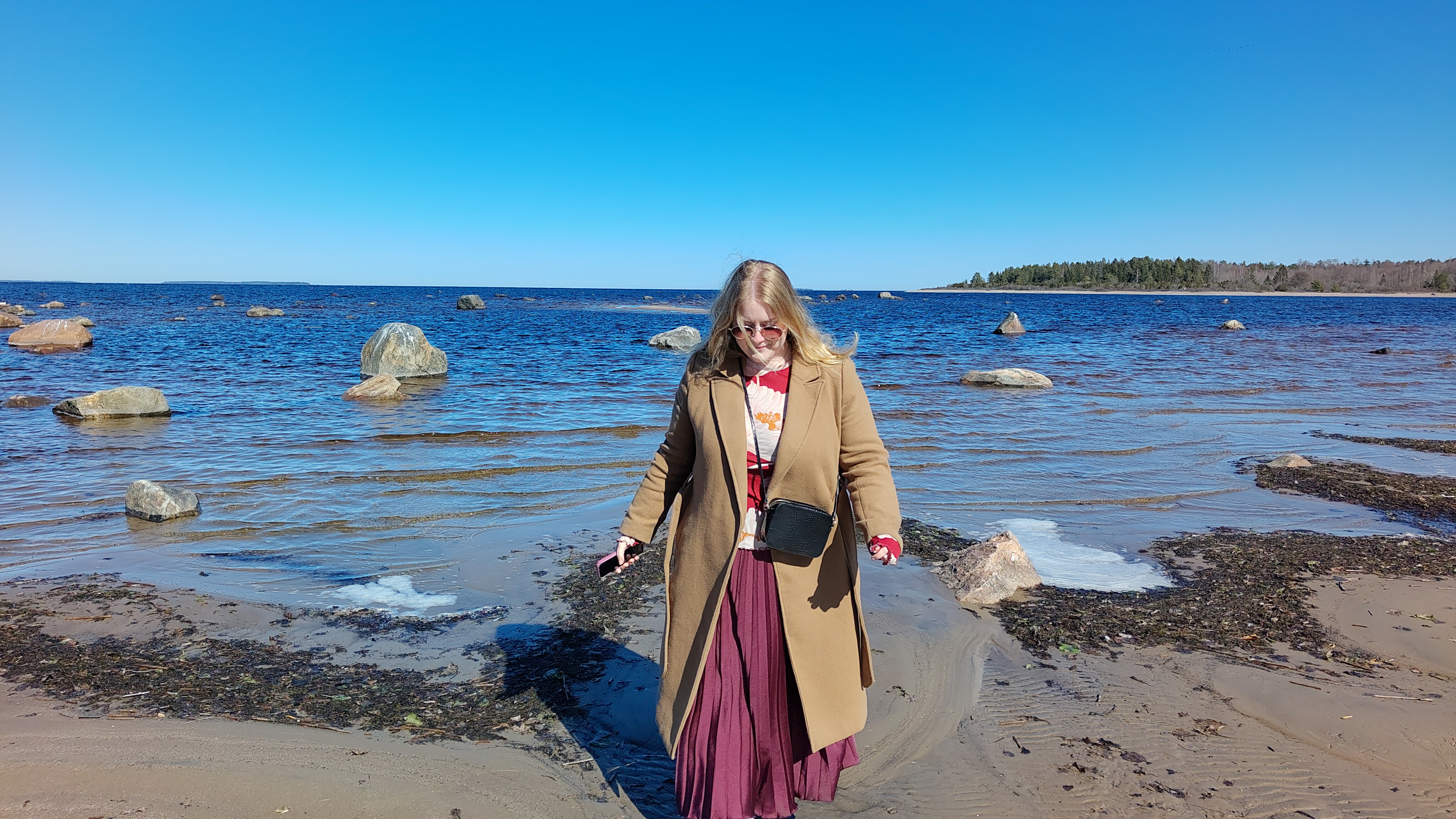
We visited the beach near Skutskär today. With the coming of spring, I spend most of my time outside, gardening, hiking, and in nature. It is, to me, a major source of energy and stimulation, and I saw a massive boost in well-being after COVID when I started going outside more.
Where does your personality come from?
In the worst-case scenario, you will go throughout your life without ever taking responsibility for who you become. Everything you do is a result of, in part, your poor genetics, in part your difficult environmental conditions. You may feel you have little choice over who you were born to be, and that you have equally little choice over your environment or how you came out.
It’s the type of person who chooses to spend every day stuck inside their apartment and who never learns that their skin and DNA thrive in response to sunlight and vitamin D. The person who doesn’t realize how exercise and endorphins contribute to feelings of well-being throughout the day. The person who doesn’t recognize how they respond to eating certain types of food.
In the case of the Individuated person, we see someone who recognizes their genetic makeup, is aware of their natural baseline, and understands how to navigate their genes and use the resources available to them to create a good life for themselves. There is wisdom in your body, and in learning to listen to it. If you spend your life trying to discipline your body, if you try to avoid listening to your body, that might work for a while, but you’ll find yourself eventually snapping back into place again. Perhaps you can lose weight for a month. Perhaps even a year. But most people eventually regain that weight, at some point or another. Discipline is always an unsustainable, short-term strategy. Wisdom is different. Wisdom knows when to apply discipline and when to relax and let go. Wisdom knows what you can handle – and what you can’t.
There is freedom in understanding what you need in order to avoid a blood sugar spike or crash. Some of your needs are deeply human and shared by people across the globe. Some needs are individual or unique to you or a smaller minority. But learning to provide yourself with what you need gives you the power to reshape your personality. It’ll be the difference between night and day.
How do you construct your own personality?
People will tell you the importance of being polite. But they might not be able to tell you how to stay patient with others, how to forgive another person when you’ve been hurt, or how to avoid being hurt in the first place. Kindness is not the result of simple behavioral change. It’s a lifestyle change. It may start with examining your sleep patterns. It might be due to changes in your body language or posture.
“The best predictor of a child’s security of attachment is not what happened to his parents as children, but rather how his parents made sense of those childhood experiences.” — Daniel Siegel, Mindsight (2010)
It may have something to do with how you approach eye contact, physical touch, or how you manage stress. In learning to listen to your body, you gain increased self-awareness and wisdom. This wisdom is what allows you not just to be kind but to stay kind, consistently, even when life is hard on you. Your kindness is not a genetic birthright but a result of allowing your best nature to come forward. Your genetics make up your natural building blocks, like LEGO, but how you arrange these blocks, that’s up to you.
This is also why it’s so hard to follow advice. In dating, someone might say
”Just be cool,” but how do you stay calm when you feel nervous, when your palms become sweaty, and when your thoughts are running out of control? Learning to navigate your body’s responses and regulate them is what we today call “Emotional Intelligence.” Perhaps it should be renamed Bodily-Emotional Intelligence? Because after all, where does an emotional response start and a physical response begin? Isn’t an emotional response a physical response? A feeling of tenseness, adrenaline… The two go hand in hand. I digress.
The point is, it’s up to you.
You have to make the steps, and you have to learn from your experiences, and through experimentation, awareness, and creativity, you’ll find your way forward in life. Perhaps you’ve grown up being called stupid by others, just because the advice they gave you didn’t work in your own life.
Perhaps you grew to think of yourself as emotionally sensitive or timid, but maybe you just never found your way to socialize or connect with the world?
The comfort zone is the biggest enemy to the project of Individuation. It discourages experimentation, and it gives you a flawed conception of your own limits. The only way to see your genetic potential is to challenge all boundaries and perceived limitations. Like a baker needs to pound the flour to make bread, you need to push and stretch yourself out to see how far you can go. In that way, I guess, discipline can still lead to wisdom.
“One can choose to go back toward safety or forward toward growth. Growth must be chosen again and again; fear must be overcome again and again.” — Abraham Maslow, Motivation and Personality (1970)
Share

Loading discussion…