
So you’re an Intuitive type, but you still feel quite proficient at Sensing.
Or maybe you’re a Sensing type, but still feel fully capable in using your Intuition.
Can you be an intuitive sensor or a sensing intuitive? And how is that possible? Let’s find out.
Getting to know Intuitive sensors and Sensing Intuitives
Firstly, Sensing types are known to be doers, busybodies that value action over theory. You might be interested in sports or athletics. People would describe you as thick-skinned, resilient, and tenacious. You might have strong attention to detail, or maybe, you’re just a very attentive and present person in general. They’re down to earth but can sometimes struggle to think outside the box.
Secondly, Intuitive on the other hand tend to be seen as Theorists. They like to approach things academically. They use philosophical or logical reasoning to speculate on what could be or think about the future. They’re typically ideators that struggle to get started. Often, they appear to have their heads in the clouds. They can be imaginative, daydreaming people.
But you feel like you’re in between on both of these things. So what’s really going on?
Sensor vs Intuitive | Intuitive vs Sensor
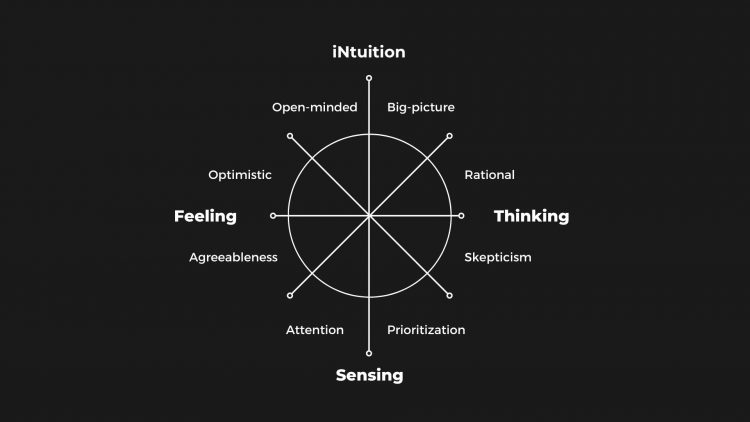
Intuitive and Sensing traits never really overlap. But a Feeling type has traits that overlap both with Sensing and Intuition. Similarly, Thinking overlaps both with Intuition and Sensing.
The four traits of an Intuitive are: Open-mindedness, Optimism, Big-picture thinking, Rational, Task-positive thinking. These traits align to create a person who is theoretical, conceptual, and imaginative.
The four traits of a Sensor are: Skepticism. Prioritization. Attention, and Agreeableness. These traits combine to create the characteristics of a person who is down-to-earth, present, active, and focused on the here-and-now.
Feeling and Thinking dominant types
When a person appears equally adept in both Sensing and Intuition we tend to say that they’re most likely a Feeling or Thinking dominant type. We could describe the Feeling types as Intuitive sensors. We could also call Thinking types Sensing Intuitives.
The Intuitive Sensor: The Feeling Dominant Type
If you’re a sensing intuitive, the reason could be that you’re a Feeling dominant type. That means you have certain sensing traits, and certain intuitive traits. Let’s break down which ones you have and don’t have.
Sensing traits
HIGH AGREEABLENESS.
You are inclined towards harmony and support. Your eyes especially gravitate towards the people, animals, and facial expressions of people. You seek to serve and work for other people.
STRONG ATTENTION
You zoom in and approach the world from a first-person perspective. You are attentive to your surroundings and environment. And you are attuned to your five senses and what you feel and experience in the moment.
Intuitive traits
LOW SKEPTICISM
You find it hard to critically dissect what somebody says and to spot issues with something.
WEAK PRIORITIZATION SKILLS
You can find it hard to select between multiple options and ideas.
The Sensing Intuitive: The Thinking Dominant Type
If on the other hand, you’re an Intuitive Sensor, we could call you a Thinking dominant type. This allows you to relate to certain aspects of Sensing personality types, and certain traits of Intuitive types. As a Sensing Intuitive, you have these traits, but not the other ones.
Sensing traits
HIGH SKEPTICISM
You take a skeptical approach towards life and new possibilities, focusing on identifying problems and obstacles.
STRONG PRIORITIZATION SKILLS
You take an organized approach towards life.
Intuitive traits
WEAK ATTENTION
You can find it hard to stay connected to your five senses and your emotions as you experience them. You often detach.
LOW AGREEABLENESS
You can sometimes be cold or detached to other’s feelings or emotions, and focus more on achieving goals or completing tasks.
Intuitives with strong Sensing
Along with this, you might also just be an Intuitive with strong sensing. As intuitives age and develop, they may be able to integrate some of the traits of Sensing and align them with their own life. For example, while as a kid, you might have found it difficult to organize your ideas and focus, as you got older, you’ve most likely gotten better at prioritizing between all your hobbies and projects.
Similarly, you might have been a Sensing type with high Intuition. Through your life, you might find that you become more and more creative, making more room for ideas and creative pursuits in your life. You might have started out with strong, passionate opinions, but gradually, you got more open-minded to alternative ways of life. You might also have been a present person, focusing on what is, but as you got older, you found it more easy to detach.
Are you a Sensing Intuitive, Or An Intuitive Sensor?
Let me know in the comments below which personality traits above you identify with the most and how you express and engage in your Intuitive and Sensing functions. Thanks for reading, and see you in the next article!
Share

Loading discussion…