
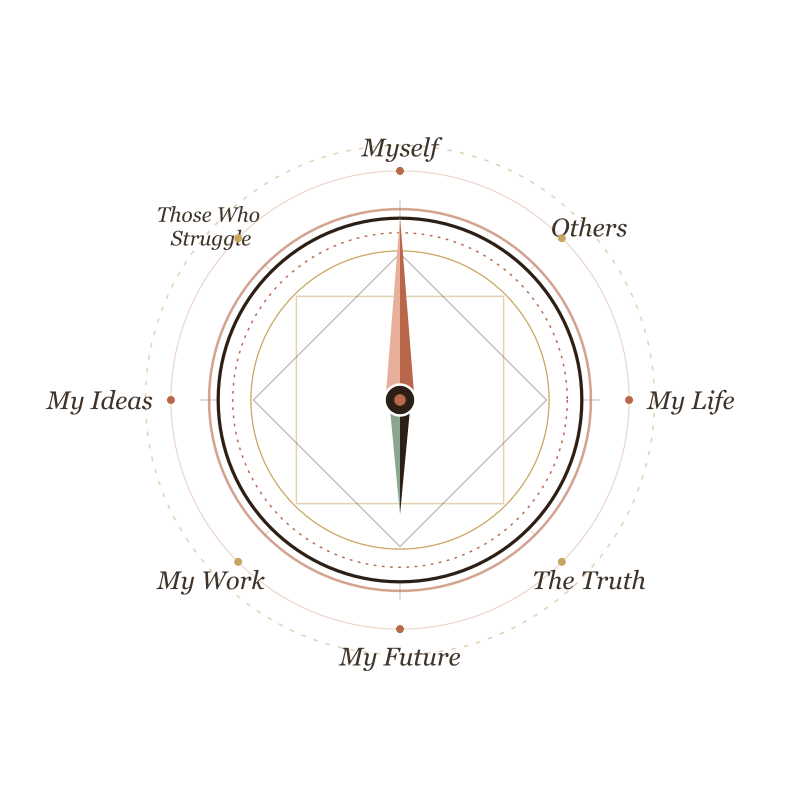
What are the eight intelligences?
Don’t think for a second that you’re not intelligent. Truth is, everyone is differently intelligent. The eight intelligences define your two biggest, most positive gifts to the world, highlighting the marvellous fact that people think and see the world differently. The Neojungian Eight Intelligences are an elegant and simple solution for anyone who wants to move past the old, less precise cognitive function model. Today I want to talk about three confusing and problematic aspects of the old system. Hopefully, that will show what Neojungian Academy is trying to change.
Measure the preference for a function, not the use of it
The traditional idea is to search for which functions are the most used by a person. The neojungian idea is to instead identify which thinking styles are the most easy, positive, and beneficial to a person. A neojungian understands that your behaviour is constantly changing and that you are a dynamic person, but that doesn’t change your type. Because to a neojungian, your type is a reflection of what you love, not what you do. To focus on what a person does is a question of stereotyping. You’re describing a person based on the environment they are in. You’re missing the deeper pattern.

Intuition and sensing is more important to health than introversion and extroversion
While introversion or extroversion is an indicator of a person’s comfort zone – where a person feels the most at ease – intuition or sensing is a reflection of energy, what a person finds inherently interesting, fun, and invigorating. It can be highly beneficial and positive for a person to go outside their comfort zone. But to act outside of your interests and to do things that you find unstimulating and boring, that’s generally irrational. That is why I tend to say sensory introversion, or intuitive extroversion, not extroverted intuition, or introverted sensing.
Discuss the similarities and differences between the types in a more meaningful way

It is somewhat correct to say that an ENFP has introverted feeling as their secondary function. The problem is that it is not the most meaningful and important part of an ENFP. Rather than to describe an ENFP as an introverted feeling type, it is better, and more meaningful, to discuss the ENFP as a feeling perceiving type. Introverted feeling is something that an ENFP can only engage in by leaving their comfort zone (extroversion). Just as extroverted intuition is something an INFP can only go into by leaving their comfort zone (introversion).
The main similarity between an INFP and an ENFP’s cognitive functions is Intuitive perceiving. This is what you use when you generate ideas and original thoughts on a work or an experience. INFPs and ENFPs are different in that one favours intuitive introversion, and one favours intuitive extroversion.
My transition past the old cognitive functions started when I came to realize that an INFP finds extroverted intuition uncomfortable and somewhat unnerving (after all, they are introverts!). Just as most ENFPs tend to find introverted feeling somewhat scary. To label these functions as secondary preferences may certainly be correct in a sense, but it’s also imprecise and misleading. You’re not naturally an introverted feeling type – at least, you’re not dominantly an introverted feeling type – you’re a feeling perceiving type. Finally, an ENFP can talk about their real differences compared to others.
So what are the eight intelligences?
They are your two strongest gifts, without an inner preference, and without labelling one as higher than the other, and they are a reflection of your most comfortable, effortless, and personally-enriching thinking style.
The idea of the cognitive function hierarchy is based on labelling and measuring a person’s preference for various cognitive functions. But instead of measuring how much a person uses a cognitive function, we should be discussing how a person feels about using a certain function. What makes you happy? And what gives you energy? What relieves you from stress and tension? That’s the question for a neojungian. That’s how we are combating the older stereotypes. So if you want to help, share this article, ask us a question, and become a Neojungian.
Share

Loading discussion…