You can choose to keep browsing social media, or you can choose boredom, what’s better?
I’m at the gym. I tell myself I need some good music to “really get into it”. But do I?
Another morning, I’m chatting to an AI, and I tell myself I’m doing “Deep Research”. But am I?
I’m out for a walk. I tell myself I’m “Just going to put on a podcast”. But what would I have done instead?
So often, my brain and my social media seem to conspire together to keep me engaged, keep me consuming, keep me online, so much, so often, that I ask myself, what would I ever do without technology?
Being a millennial, I can actually remember a time in my life when I didn’t have any technology, no phone, no computer, just me, myself, and I. I could spend hours by myself, doing absolutely nothing. I know what childhood me would say. He would say the following:
“I never get bored, because I enjoy my own company.” I like his attitude. It’s true, as a kid, I always had fun. My own mind was my playground, and I’d spend hours in a car, just looking out the window, but my mind would buzz with stories, games, and funny thoughts.
But when and why did that change?
What Social Media Does To Keep Your Attention
I’m currently engaged with a project of reclaiming boredom. I’ve tried many times over the years, and never really succeeded. I tried dumbphones, I tried smart app locks and timers, and I tried leaving my phone behind, but five minutes later, my brain would find a reason to take it back and go back to browsing. I felt like a hopeless case. Why was this so hard? And why was I trying to quit in the first place?
Fast forward, and I started changing how I thought about the content I consumed. I quit reality TV around age 27, and I don’t miss it. I became aware of a popular phenomenon that manipulates your attention: manufactured outrage, drama, fearmongering, clickbait, and all the ways people trick you into paying attention. Social media, in essence, will do anything to make you mad at someone. Make you afraid of something. Make you laugh at someone. Reality TV is an engineered experience where people behind the scenes write the stories and scenes themselves and push and nudge the participants to perform, like they were in a circus. The only way to get on is to play the game and do what they say. The one that bothered me the most was arguably Love Island, where several contestants ended up taking their lives after the show, and where mental health issues and plastic surgery were a part of the package.
These shows and these social media sites put you in a filter bubble and serve you anything that keeps you sitting down and consuming. Hours later, you’ll have forgotten the time entirely. Did you enjoy it? What was the most noteworthy post you saw? Will you remember it tomorrow? Most of the time, when I observe people sitting out having dinner with friends, everyone is on the phone, scrolling. Their facial expressions are neutral, if not bored. Sometimes they’ll giggle for a minute. A quick release of dopamine, then back to scrolling. Social media works not because it gives you what it wants, but because it’s able to promise you what you want, and keep you excited for what’s next.
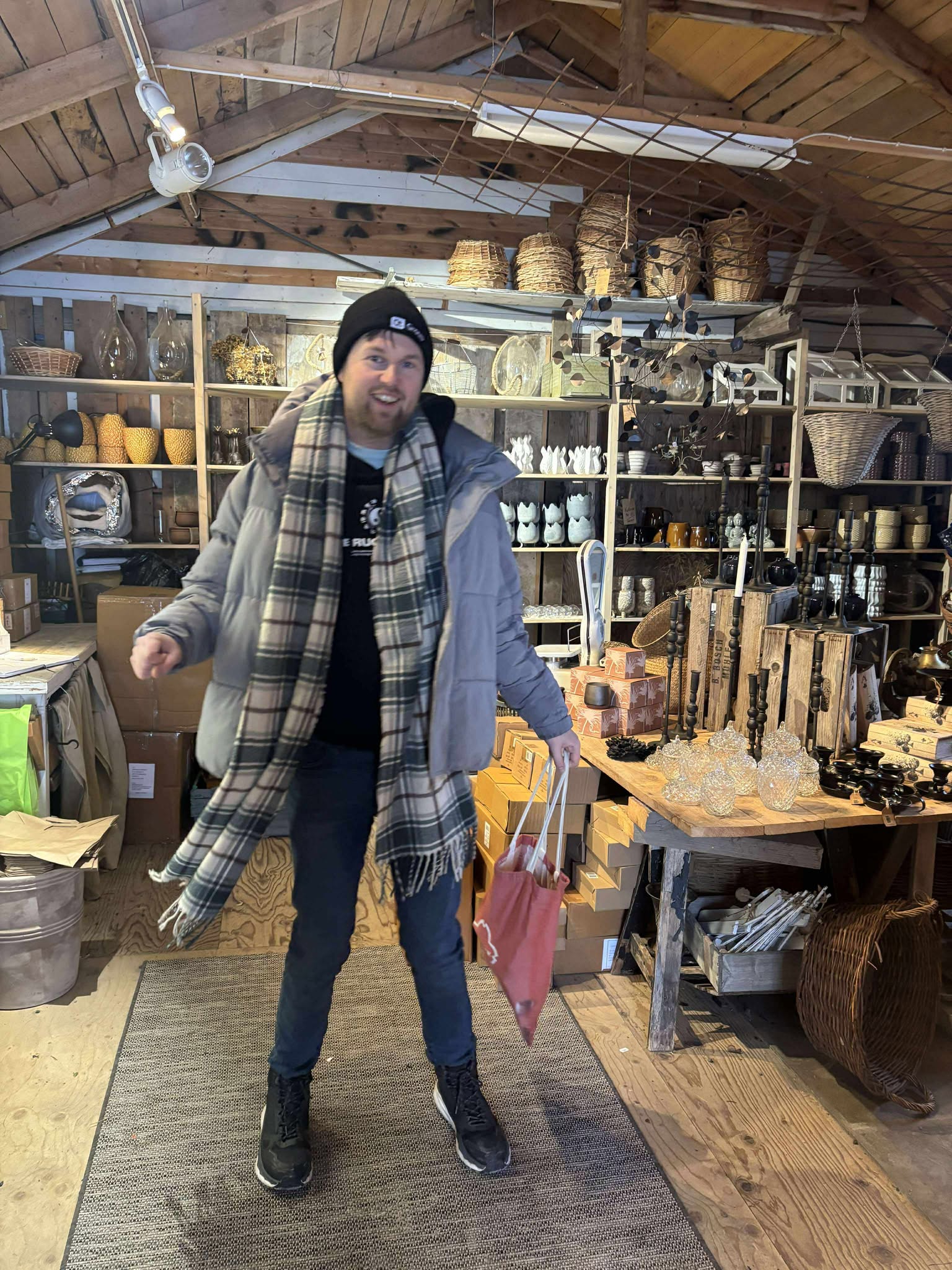
We took the car to visit a nice cafe in Upplands Väsby, Sweden this weekend. This is me dancing in their store!
But what if I only consume healthy media?
This made me subscribe to independent newspapers that promoted slow journalism. It made me look up interesting experts and podcasters who could offer more interesting insights. If I’m the sum of the five people I spend the most time with, I’d rather it be with people who make me grow as a person. I started clicking “Not Interested” on videos and news I didn’t like. I tried to train the algorithm. I tried Incognito Mode. I tried Ad Free. The problem?
What if these “expert podcasts” and “deep dive articles” are just another way my brain tried to manipulate me to stay online?
Yeah. I had to think a bit about that one. I could spend hours digging into neuroscience, listen to Sam Harris for hours, and finish a book a day if I committed to it. 2025 was the year I read the most in my entire lifetime. But how much of it do I even remember? Was I ever able to put any of it into practice? Does all content need to be useful? What about fiction? It helps me relax. Was I just being overly critical of my “healthy habit”? Let’s not kid ourselves. I’d listen to the podcast for an hour, and then I’d tell myself: “Now, I’m so tired from learning these interesting things, I’m going to put on a fun show on YouTube for a while, that would become an hour, that would become an evening, and boom, we’re back to the core problem. Isn’t it fascinating how the human brain works?
How I’m Working To Reclaim Boredom
Recently, I finished The Martian by Anthony Weir. I’ve been really enjoying his science fiction lately, and read Project Hail Mary a few weeks ago. A thought that arrived in me was: How did Mark Watney manage to spend so much time alone? Sure, he had his disco music and his 70s shows, but most of the time, he had nothing and nobody but himself to keep himself entertained. And he seemed to be doing a great job of it. Perhaps he’s not a realistic character; most of us would probably go insane if we had no social contact for so long. But I know of monks who live in monasteries, spending lifetimes away from civilization. So what gives?
I like to believe that I could do fairly well on my own. I have had practice. While you might say that YouTube and social media have killed my attention span, and it probably has done a lot of harm to my brain over the years, I don’t think I’m broken by any metric, and I like to say that, if the internet were to go out, I’d be alright. I think that’s true for most of us. We may be addicted to algorithms right now, but I believe that if the internet went down, we’d get on with our lives. I think a lot of us wouldn’t even miss it.
There’s something to that. I’ve been able to go cold turkey on many addictions in the past. I could give up coffee for years, just to show myself I could. I was able to stop eating candy at age five, and I don’t drink any alcohol. I’ve been a practicing vegan for eight years, and while I’m now an omnivore, I can recognize the effort and hard work it took to change my diet and lifestyle around on a whim, just through sheer willpower. Why couldn’t I do it this time?
How I Found Salvation
One thing that helped me was a mantra:
There’s nothing for you there.
Whenever I’d pop up my phone or type reddit…. I’d stop myself and say:
There’s nothing for you there, Erik.
Because it’s true.
None of the posts on these media sites has anything to do with me. There’s nothing I can do about any of the events I read about online. I don’t live in the US, yet US news occupies 50% of my social media. Most of the headlines are about people I don’t know or care about. Even the experts and podcasts I’d listen to could turn out to be distractions. I’d have to genuinely ask myself: Do I really need to study economics? Does it really benefit me to learn from this depressive academic? Why should I read this long article about the history of the concept of the soul? What’s the point of all this needless theorizing or trying to predict a future I’ll never know for sure anyway?
Sometimes, I’d find genuinely useful stories and articles that offered me personally applicable advice I could put into practice in my own relationships, my work, or my writing; other times, it would turn out to be just a pure distraction. I’d realize I was giving somebody online way too much power over my time and day.
How much idle time do you need?
I sat down and asked myself:
How much idle time do I think I need?
I get 8 hours of sleep every day. But I believe we need more than that. Imagine if we had even 1-2 hours a day?
Idle time isn’t “do nothing time.” It’s time when you turn off all the music, shut off all the shows, put down the books, and just sit with yourself in stillness, doing nothing. You can engage in idle time when you’re taking a shower, a walk, or when you’re on a short break from work.
I like to call this time “Prime Time” because that’s when one of the most interesting shows of all time comes on: Your show.
This is when your mind starts buzzing with ideas, plans, and coulds. I know, sometimes you feel guilty about that too. Why can’t you just shut your brain off? But there’s nothing inherently wrong with spending five minutes in contemplation and then realizing you want to play some piano. That was actually the promise and possibility of idle time. It can unlock opportunities in you that you’d otherwise miss. Once you’re done playing the piano, you can come back into idleness once more, and maybe ten minutes later, you’ve got an idea for a quick short story on Substack. (Hey, that’s why I’m here right now!)
The key is we need idle time, and lots of it, as often as possible, in the bathroom, on the walk, on the bus. Idle time can enrich your life by unlocking the potential you have locked inside. Enjoy it. Be your own best friend. They say it’s good to be bored. I say you’re never bored if you enjoy your own company. I’m saying: There’s nothing there for you online or on the shows you like to watch. You don’t really enjoy it. You won’t remember it. It won’t impact your life in any meaningful way, but these five minutes you sit down with yourself, in silence, will change your life for the better. Try it!
Share

Loading discussion…