I thought I could get rid of my insecurities by working day and night to overcome my flaws. But my insecurities only got worse.
In this article, I’m going to share a personal story of mine. You see, I always had a lot of insecurities about myself. I never felt like I was enough. I always thought I had to work harder – to try to improve myself, to be a better person. And those thoughts continued to haunt me far into my 20s. Let me explain.
The head of the Green Party, Annika, called on a Tuesday afternoon. Erik, we need somebody to come to the school. Talk to the kids about the party, the election. We think somebody young and more relatable would be better.

This is a photo of me back in 2010, when I was in the Green Party.
I thought of saying, “Why me?” Instead, I said, “Yes, of course, I’d love to!” I thought of sharing the cold dread spreading through my chest. Instead, I said, “I’m so excited!” I thought of saying “I don’t really know how to do this, could you help me practice?” Instead, I said, “What time does it start?”
I didn’t want to sound weak.
“Tomorrow at 9.”
I swallowed. I spent the rest of the day studying and rehearsing deep into the night. I barely slept. I woke up feeling sick, printed notes in hand, none of it useful. When it was my turn to introduce myself, I mispronounced my own name. I spoke fast and quietly, a deadly combination. Nobody could understand anything I said. I could see people laughing. When I got a question I didn’t know the answer to, I made one up that made no sense. The others on the panel looked at me with a mix of confusion and pity.
There was a second debate scheduled that same day, at another school down the road.
I found the nearest bathroom and stayed there for an hour, sitting on the closed lid of a toilet with my coat still on. I thought about calling Annika to cancel, but she didn’t pick up. I thought about leaving. I had no excuse that would hold. And somewhere in the exhaustion of that, something shifted. My mind went quiet the way a room goes quiet when the last person leaves.
I started breathing. Slowly. I breathed until there were five minutes left, and then I walked out.
I don’t know exactly what happened in that second debate. I know I looked at people instead of away from them. I know something came out of me that hadn’t been there an hour earlier. I was funny. I was, apparently, convincing. People laughed at the right moments.
Then I went home, and the next morning I woke up with the same fear I’d woken up with the day before.
I started scrutinizing everything I had done. I thought only of the mistakes. I couldn’t remember any of the positive feedback anymore, or it didn’t matter. The only thing that mattered was when and how I had somehow messed up. So I kept rehearsing. I kept preparing harder, working longer, trying to condition myself out of the nervousness by proving, over and over, that I was good enough. Every successful speech fed the next round of preparation. Every round of preparation fed the fear that made it necessary.
I was using anxiety as fuel. Which meant I needed to keep being anxious.
The thing I was trying to eliminate was the thing keeping the whole system running. I didn’t know that then. I just knew I woke up afraid, worked until the fear quieted, went to sleep, and woke up afraid again. I thought I was solving a problem. I was maintaining one.
This is what most self-improvement actually is. You find a flaw. You work on it. You get better. The improvement is real. But the work never stops, because the whole project is powered by the belief that something is fundamentally wrong with you, and that belief doesn’t go anywhere just because you got better at a speech. It needs the flaw. It goes looking for new ones when the old ones fade.
Think about what it means to work on your confidence. Every hour you spend working on it is an hour spent confirming that you don’t have it. Every technique you practice is a reminder of the gap between who you are and who you’re trying to become. The gap doesn’t close. You keep measuring it, and the measuring is what keeps it open.
What is the insecurity you keep working towards, but which never goes away?
Or take the way most people talk about authenticity. Be your true self. Discover who you really are. Find your voice. All of it sounds like freedom, but underneath is the same assumption: that you are currently not yourself. That the real you is somewhere further along, waiting to be reached after enough work, enough journaling, enough therapy, enough podcasts about being authentic. You might spend years in pursuit of yourself and arrive, somehow, feeling further away.
Here is what I think is actually happening. The self you are trying to build is standing in the way of the self that is already there.
That sentence took me a long time to mean anything. It sounded like something you’d read on a poster. But I kept coming back to what happened in that bathroom, to what came through in the second debate, and I started to notice that it only arrived after I stopped. After preparation had run out. After I had nothing left to perform.
It wasn’t that I became someone better. It was more like something got out of the way that had been holding me back.
You can’t rehearse that. You can’t add it to a morning routine. The whole logic of self-improvement, the constant measuring of distance between who you are and who you could be, is precisely what prevents it. You are so busy building the person you think you should be that you never find out who is actually there.
This is the question I keep sitting with. Not how do I become more confident, more authentic, more present, but what am I doing that is making it so hard to be those things already? What layer of effort, performance, and working-on-myself is sitting on top of something that was there before I started trying?
I don’t have a clean answer. But I wrote a book about the question. It’s called The Age of Self-Realization, and it starts from the idea that self-realization is not the same thing as self-actualization. Self-actualization is the project of building a better version of yourself. Self-realization is discovering who you already are when you stop. The book grew out of years of doing it the wrong way first, and slowly, reluctantly, noticing that the wrong way was the problem.
When I look back, I realize that so many of my issues were authenticity problems. Fears of being vulnerable. I could have told the head of the Green Party about my fears. I could have told the kids in that school it was my first time and that I had barely had any time to prepare. I could have shared something real and personal I was feeling at that time. Something that would have helped the audience relate to my situation. But I thought I had to be, say, or do something more. I had to maintain a convincing persona for the world. I had to “fake it until I make it.”
I could have shared something personal- like why I had decided to join the Green Party in the first place, what my concerns were about the environment. If I had a question I didn’t know the answer to, I could have said, “I don’t know, but I can look it up for you!” And most of all, I could have made my life so much more comfortable for myself and my nervous system. I could have been kinder to myself along the way. I could have spoken to the people in the audience the same way I would have spoken to a friend, when sitting next to them during lunch.
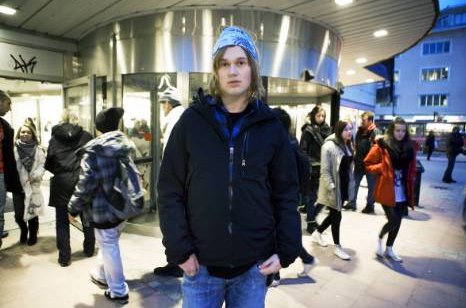
This is a photo from a 2010 newspaper article in which I was interviewed about overconsumption during Christmas. Give each other more thoughtful, meaningful gifts, and less plastic junk, I said.
I know one thing: Why the second debate was so different. You see, during the first debate, I had been surrounded by strangers, people I didn’t know. The second debate was in front of several friends and my teachers. People I knew, liked, and trusted. People I knew liked me. With them, I realize, I could be myself. They would understand how I thought, how I talked, and how I felt, because they knew me. I had no need to put on a perfect persona for them. Because they knew me without the mask. And they liked me without the mask.
If any of this feels familiar, it might be worth reading on. Not because it will give you something new to work on. But it might let you put some things down.
Loading discussion…