It’s 2 pm, and I’m at the office. I just received an e-mail: “Why has this issue not been resolved yet?” I feel a strong discomfort running through my body. I don’t know whether to defend myself…
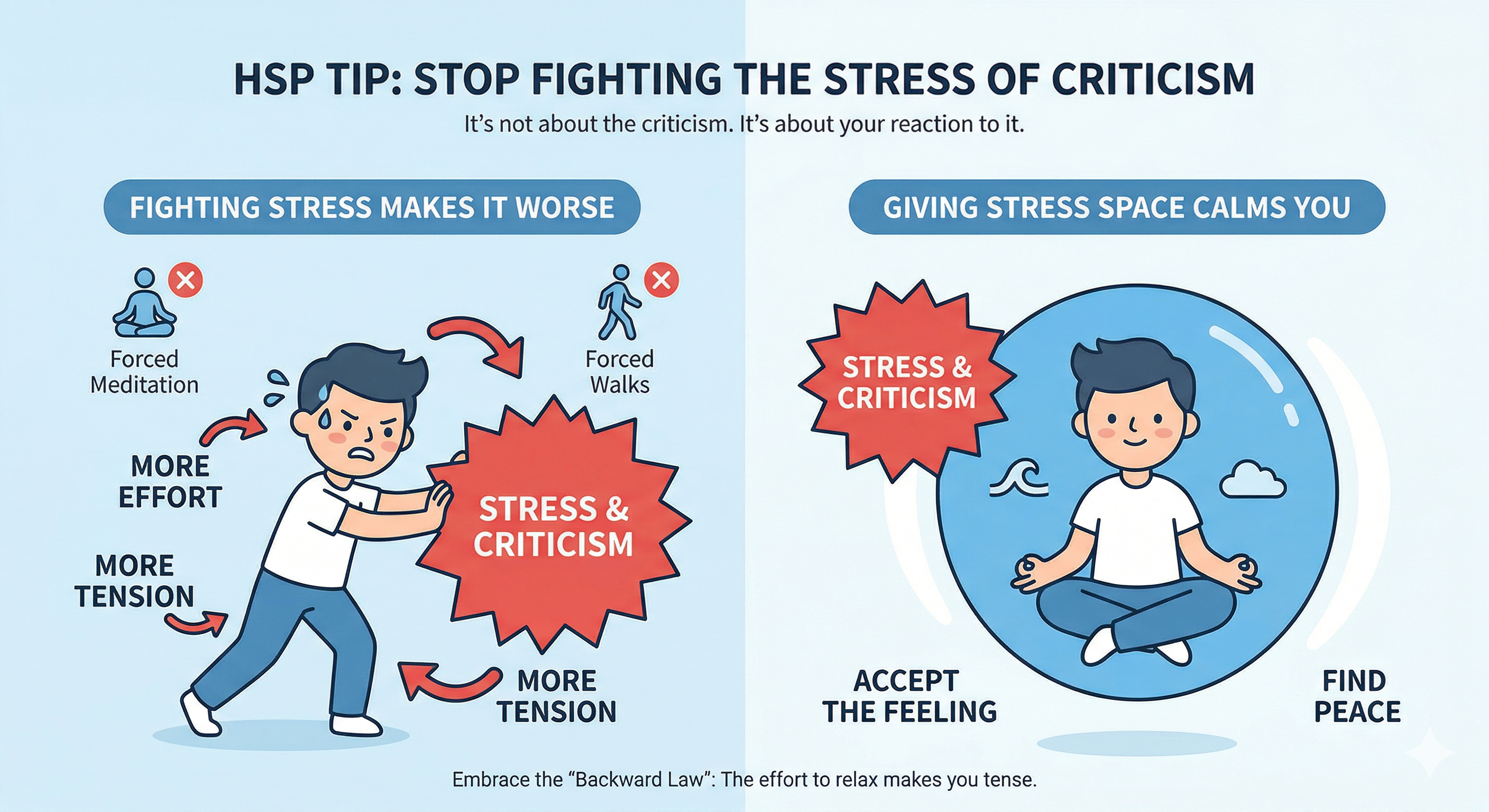
It’s 2 pm, and I’m at the office. I just received an e-mail: Why has this issue not been resolved yet? I feel a strong discomfort running through my body. I don’t know whether to defend myself or apologize. What I do know is that, over the past weeks, my nervous system has been slowly winding down. I’ve worked hard on my breathing. I’ve meditated. I’ve gone on walks.
But nothing seems to make the feeling go away. In fact, the effort of meditating, of going on walks, of forcing myself to relax takes so much effort that I end up feeling more stressed and more tired, and I realize in that moment the futility of fighting this emotion. I realize I’m just prolonging the inevitable crash. At some point, I’m going to have to reconcile with this stress, no matter how great I become with CBT and emotional management; at some point, I have to sit down and face these emotions. And that starts with changing how I identify with them. I may think that, as a highly sensitive person, I am wired to feel more stressed, more nervous, more anxious. But that is far from the truth.
It’s important to recognize that being Highly Sensitive has little to do with how you receive criticism; it simply changes how you process sensory information. When you feel nervous or rattled, it’s not because of your heightened sensitivity. HSP is not meant to mean “sensitivity to criticism” – it’s meant to mean sensitivity to sensory stimulation. There’s a different reason why you respond so strongly to criticism. Let’s talk about what that reason could be.
The Hit to the Unconscious Complex
Carl Jung said that when we feel sensitive, it is often because we have been hit at an unconscious complex. I’m very people-oriented; others’ feelings are very important to me, and often I feel I need to demonstrate impeccable skill and ability in what I do to be loved by others. In short, I have a bit of a hero complex.
For example, I often feel like I’m not enough, that I’m somehow lacking or deficient. I am not able to help other people, or I just end up making things worse if I try, and no matter what I do, I will never be able to keep up with others’ expectations. The e-mail can serve as proof of that. But it is not proof of that at all.
Nothing I do will change the fact that there will be hard work to be done and things to improve. I can work harder and faster, and I’ll still miss something, fail somewhere, and get stuck somewhere. I can close ten issues, and ninety new ones will appear. It reminds me that I can’t soothe my nervous system with the very thing that made it frazzled in the first place. If I am being rushed, rushing will not make me feel better. If I am being attacked, attacking or defending will not make me feel better. If I am being criticized, criticizing myself or the other person will not make the situation better. You can’t regulate the nervous system by further disrupting it.
Alan Watts and Aldous Huxley often spoke of the “Law of reversed effort” or “Backwards Law”. It means that the very effort to relax makes you become tense. Oliver Burkeman often points out that instead of fighting the stress, it’s often better to just feel it and give it space. The effort I put into relaxing still takes effort, and it’s not relaxing at all.
The Cultural Barometer of Emotion
Carl Jung instead invites us to examine our personal complexes and to learn to reframe our personal beliefs about ourselves and the outside world. And over the past years, I’ve been carefully dissecting my own views, and what I’ve come to realize is that I have tried to dramatize something that is strangely undramatic. You can’t change nature or your response to it, and you can’t control how other people feel or respond, so your only choice is to change how you respond.
Everyone has their own cultural barometer of what is considered appropriate when giving or receiving feedback. In the Netherlands, I was taught that the Dutch are direct with feedback, objective, and neutral. They will call out problems and issues with little regard for your emotions. They’ll expect you to get things done and to address the feedback objectively. The Japanese are often said to be polite and agreeable, to keep their thoughts to themselves, and to avoid offending. The Americans are said to be excessively optimistic and positive, and to hide personal flaws and insecurities. The Scandinavians are said to be humble and harmony-oriented, to seek consensus, and to avoid exaggeration.
Who is to say what the appropriate way to be emotional is? What is the appropriate way to express that you love or appreciate something? What is too much or too little? It is important to think of it as an emotional barometer, and to recognize that what qualifies as “healthy expression of feelings” varies from culture to culture. It is not that a specific culture is cold and another is emotional; it is that what we perceive as cold or emotional depends on how we understand and interpret it.
When one person says “I love you”, they mean “I like you” and when another says “I like you” they mean “I love you”. Similarly, when one person says “This sucks.” they mean “It was ok.” and when another person says “It was OK.” they mean “It sucked.” — it’s important to understand people for what they really meant rather than what we or our culture might think it means. To ask questions to clarify. How we interpret something is our own interpretation, not the truth. We must learn to look past what we think things mean and get down to the truth, what they actually mean.
Tip: Erin Meyer speaks of The Culture Map, which maps how cultures diverge.
This also changes how we interpret people and ourselves. We may think that somebody must be a “Feeling type” just because of their Spanish, passionate way of speaking, and that someone is a cold Thinking type, because of their Scandinavian, calm way of speaking, but people must be understood for what is underneath their cultural mask, or we misunderstand them. We read into and make assumptions that aren’t there, which lead us to form relationships based on misunderstandings about a person rather than on the complex reality of that person.
The Hero’s Journey vs. The Reality of Work
Normal office flow will always include e-mails, tasks, and work to be done, and once the work is done, new work will pile up, and the people you work with will always seek to get the best solution possible, and will always take a critical look to identify ways to improve on what is offered, no matter how perfect, no matter how much, it is the nature of a stakeholder to want to act as a stakeholder; and when they are signaling problems and new issues, they are doing their job, and expecting you to do yours.
And ultimately, you can only do what is in your nature and power, and you only have control over what you can control. We have to find peace in pushing the boulder at a comfortable pace, knowing that if we push too hard today, we’ll wake up tired tomorrow, and the total distance of the boulder will remain the same over a longer time frame. So what is the point of rushing if we know it means we will have to slow down later?
The dramaturgy of my mind has a different story, however, one where I am the hero, meant to slay the dragon (solve the problem) and leave a better world, a place where there are no problems, and everything is perfect. Such a world does not exist, and will not exist. As long as the hero stands, new problems will be presented. My hope for an existential salvation or a utopia where I can finally “rest” will never come to pass. I have been clinging to a fantasy, a false utopia.
In this moment, I take on the role of Sisyphus, who according to the Greek Myth was condemned to push a boulder up a mountain for eternity, and in a way, life is a lot like that, most days repeat themselves to some degree, and there is a familiarity to the everyday struggle, a bee will wake up, and go searching for flowers and nectar, and the next day, he will continue in his search. Yet, Camus said we must imagine Sisyphus happy. Perhaps we can still take joy and contentment from work, even pride? Perhaps there is nothing wrong with this? Why are we looking for an escape from the very nature of life?
If I can accept that work will always require work, and make peace with that, I can change my approach to the work. So instead of trying to conquer the problem, I am asked to prioritize between the problems; instead of meeting expectations, I’m asked to negotiate them; and instead of trying to please everyone, I’m asked to at least try to please myself.
The Space Between Stimulus and Response
We in the Western world are rational people; we think that when an emotion comes up, the answer is to jump to respond to it logically. I would urge you to instead take five seconds to introspect and reflect, and to recognize the emotion before you do something with it. There are so many times when we think we are behaving logically, when in reality, we are acting irrationally. Even if it feels like it makes sense to do something in the moment, it doesn’t mean that it’s the right thing to do. We may need to stop and ask some questions first.
What was really said in this situation? Not “What did I perceive them to mean”?
So often, we get stuck on the implications of an e-mail, what could be said in between the lines, we may go into catastrophe scenarios, we may perceive ill intent, we may worry we’re going to be fired, miss a promotion, or that we’ll end up in a conflict with someone, or that they dislike us as people. It’s so important to realize that everyone is just trying to get their job done. A lack of an emoji is not a sign of anger, just efficiency, and a lack of praise for a job well done is not due to ingratitude.
At the same time, we all have a job to try to be as human as possible with one another, not to rush work meetings, and not to shrug off the emotional reality of the people we are dealing with. It’s important to know how your teammates are feeling, if and when they feel tired, stressed, or anxious, to take a moment to hear them out, and to leave space for people to introspect and reflect on their situation and experience at work. Scheduling meetings with your team to catch up, to write and speak about how we have felt this week, what has been well, what has not been so well, and understanding where people feel stuck, and where and when they’ve had a success at something, that gives peace of mind and relief to everyone.
We are not alone in our drama, highly sensitive person or not; we are all sensitive in some regard, and we all share in our complex struggles and doubts. When other people seem tough or thick-skinned, they may still feel bothered by something we can’t see or know. I think our goal should be to try to find the joy in everyday life, the joy of comfort, sharing, love, and compassion for one another. We have a job, and it is not what we think it is. It is not to do the task, to push the boulder, but to love the people we meet and work with, while we push the boulder. To love the grass, the bees, the flowers, along the way up the hill. To love the breaks and the moments while we let go of the rock, and to love the exercise, the stimulation, that we find in pushing it onwards again. To love the beautiful sensations our heightened sensitivity will give us, to the textures, the wind, the colors, the sounds.
Loading discussion…