Perceiving: Staying Flexible, Exploring Possibilities & Loving Your Ideas
Understanding your drive to adapt, explore possibilities, and commit to bringing your ideas to life.
Why I Love · The Practice of Love
Perceiving Is Love of Ideas
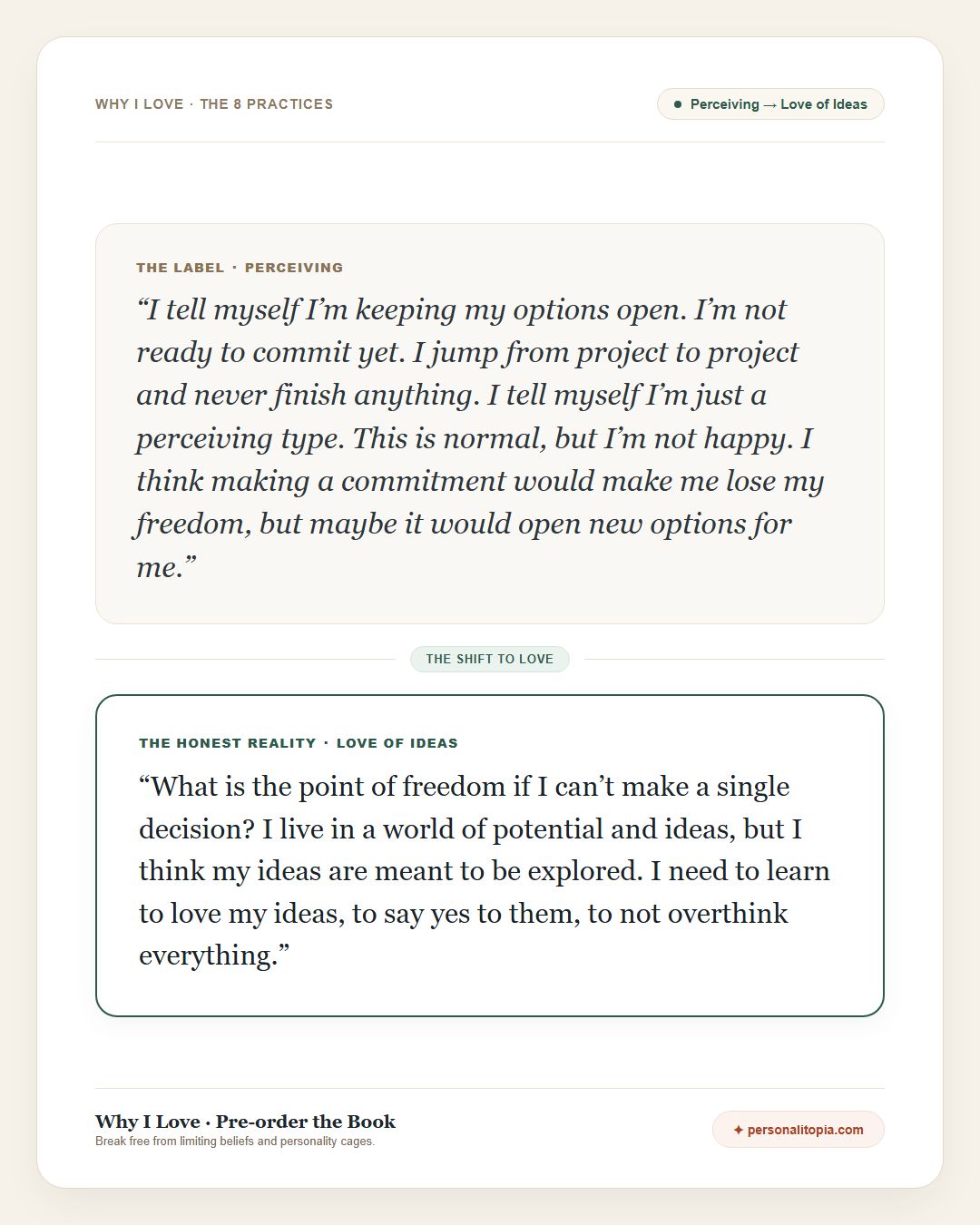
I tell myself I’m keeping my options open. I’m not ready to commit yet. I jump from project to project and never finish anything. I tell myself I’m just a perceiving type. This is normal, but I’m not happy. I think making a commitment would make me lose my freedom, but maybe it would open new options for me.
What is the point of freedom if I can’t make a single decision? I live in a world of potential and ideas, but I think my ideas are meant to be explored. I need to learn to love my ideas, to say yes to them, to not overthink everything.
What It Means
Perceiving is your drive to explore possibilities, adapt to changing circumstances, and stay open to fresh information. When this preference is driven by fear, it turns into endless option-hoarding: you jump from project to project without finishing anything, tell yourself you are just keeping your options open, and worry that committing to any single path will destroy your freedom. But perceiving, at its heart, is the practice of love of ideas.
“Perceiving is learning to love your ideas—daring to say yes to them, step through the door, and discover the new freedom that commitment unlocks.”
When you practice perceiving with love and commitment, your natural adaptability becomes a creative force. You notice subtle opportunities that rigid schedules overlook, pivot gracefully when circumstances change, and bring playful spontaneity to problem-solving. But you also realize that ideas are meant to be explored and lived, not just held as distant, safe possibilities. Making a choice for today does not trap you; it gives your ideas a real chance to exist in the world.
When this drive becomes unbalanced, you can get trapped in endless second-guessing, delay decisions out of fear of missing out, or passively resist structure. Loving your ideas means saying yes to one, taking action, and discovering where it leads.
Core Traits u0026 Preferences
Perceiving Match
Check off statements above to calculate your match score.
Your Personality in Context
At Work
In professional settings, your perceiving nature drives you to excel at troubleshooting and real-time adaptation. You thrive when projects require quick pivots, practical workarounds, and experimenting with new solutions. You notice emerging opportunities that rigid plans miss. Setting clear boundaries on research ensures you make timely choices and keep work moving forward.
In Relationships
In personal relationships, your flexibility shows up as open-minded listening and spontaneous companionship. You adapt easily to unexpected plans and handle disagreements with patient understanding. Making clear commitments on important shared goals helps the people close to you feel secure.
In Groups
In group settings, your flexible approach helps teams resolve conflicts and adapt to changes. You offer creative middle-ground solutions and remind others that rigid rules are not always necessary. Stating your position clearly ensures your voice is heard in group decisions.
On Your Own
When you are on your own, your perceiving nature leads to open-ended learning, exploratory hobbies, and creative discovery. Solitude gives you space to process new information without external pressure. Setting simple intentions for your private time keeps your freedom focused and productive.
Four cognitive function thought patterns
Perceiving shows up in four distinct ways across the cognitive functions.
1. Practical troubleshooting (Thinking Perceiving)
You focus your open perception on flexible problem-solving, hands-on fixing, and evaluating practical alternatives. You tackle unexpected technical or logical challenges as they appear, finding workable solutions rather than relying on rigid rules.
“I adapt to unexpected challenges, using flexible logic to solve practical problems.”
Learn more about Thinking Perceiving
2. Authentic inner discovery (Feeling Perceiving)
You search for deeper authenticity and personal honesty, seeking to understand your emotional life and values. You examine your past choices and evaluate whether your current direction aligns with your true character.
“I explore my history and values to understand who I am and build an authentic life.”
Learn more about Feeling Perceiving
3. Seeing potential for change (Intuitive Perceiving)
You focus your intuition on seeing potential, imagining how situations could be different, and bringing about meaningful change. You naturally spot room for improvement and imagine better alternatives for your environment, work, or lifestyle.
“I see potential in everything around me, constantly imagining how situations can change and improve.”
Learn more about Intuitive Perceiving
4. Direct sensory mastery (Sensory Perceiving)
You focus your sensory perception on getting more value, enjoyment, and practical results out of what you already have. You prefer hands-on involvement, mastering current crafts, and extracting deeper satisfaction from shared experiences.
“I stay engaged with what I have, finding ways to extract richer value and deeper satisfaction.”
Learn more about Sensory Perceiving
Journal Prompt
What is one idea you have been holding back on out of fear of losing your options, and what would happen if you said yes to it today?
Loading discussion…