Traditionally, it’s been said that the normal INFJ uses a certain amount of functions, in a particular order, to a certain degree—an example of an INFJ:
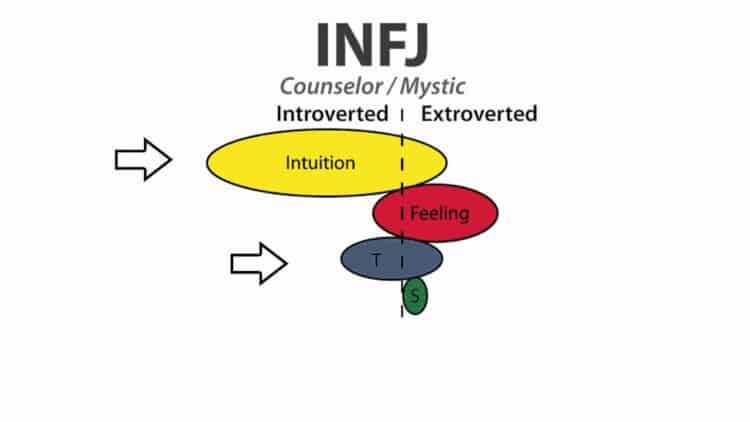
But what if this is not the case for a healthy or self-actualized person? What might a cognitive function hierarchy look like for a person who has worked on themselves, developed a healthy lifestyle, and balance between their inner dreams and the outer world?
What is D-Cognition
Abraham Maslow argued that most people are driven by D-Cognition, where the D stands for Deficiency. Because the average person feels that they lack some vital need, for example, food, they act out of deficiency or hunger. Such a person has a limited cognitive perception of the world. A starving person sees everything as something they can eat or cannot eat.
What if an INFJ operates out of a state of Deficiency?
They’d be blinded by their Introverted Intuition and their need to engage in this world. They might spend a lot of time in their own head and tell themselves this is the only real world.
They might act out of a need for security, to protect themselves from the influence of Extroverted Sensing, which they would regard as a malicious or unhealthy function.
Or they might act out of a need to prove themselves to the world, establish their vision of the world as true, and prove their theories as accurate.
As you can see, B-Cognition operates from a biased, selfish, self-centered perspective on the world, where our perception is limited by our biases, negative feelings, and a state of neurosis.
What is B-Cognition
B-cognition is the alternative proposed by Maslow. B stands for Being. Instead of operating from a state of lack, instead of engaging in what Carl Jung would call overcompensation, the person would operate from a feeling of abundance, having, and being.
I feel that I am enough the way I am.
I can do anything I set my mind to.
I have already done things that I feel happy with.
I have people in my life for whom I feel grateful.
I am not envious of other people.
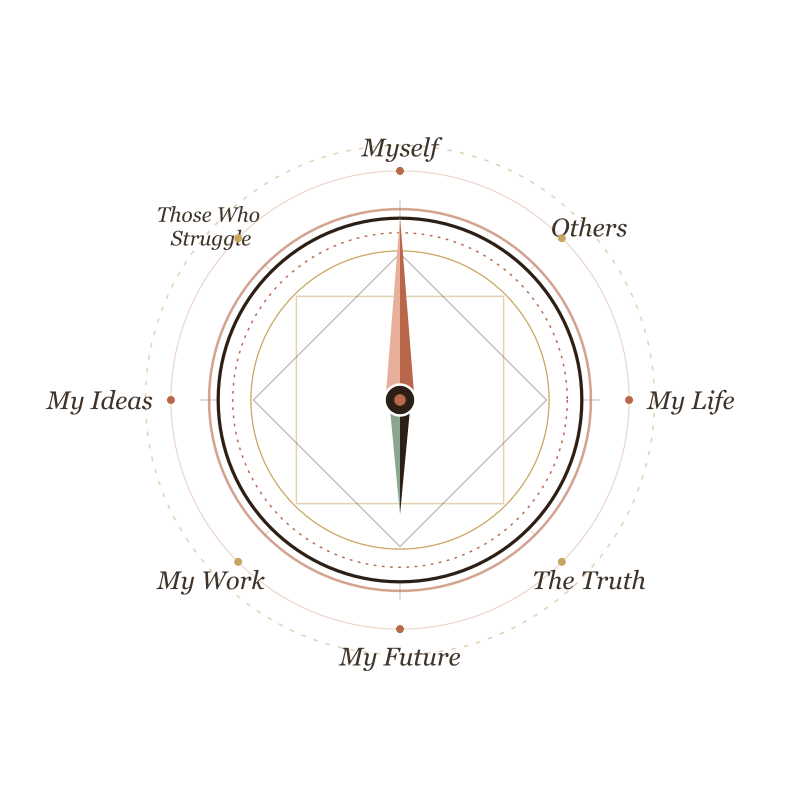
I don’t compare myself to others.
I often experience awe and wonder, so-called “transcendental experiences.”
In Maslow’s view, people exercising B-cognition would use their whole brain and have a more full and holistic view of life. Instead of seeing it from the framework or perspective of their personality, they see it from the view of a wise person who has understood the duality of life and personality and come to integrate different traits into their lives.
B-Cognition and Personality
In Maslow’s view, B-cognition makes it necessary for a person to achieve Integration.
You can’t look at your inferior function as an enemy, you can’t harbor judgment towards others who are not like you, and you have to understand how other people and their personalities align with yours.
B-cognition doesn’t necessarily mean a person doesn’t have a personality. They will most likely have a very strong, inspiring personality. B-cognition is a result of a person having achieved self-actualization. Such a person is no longer trying to prove themselves or their worth in the world, no longer competing with other people for success.
However, most likely, the personality of an individuated, transcended person cannot be described using one of the 16 classic personality types or one single cognitive function.
They will likely have multiple cognitive functions, which they have mastered to a high degree.
On top of that, they have individuated these functions. With that, I mean, they have made this function their own.
Instead of using Introverted Intuition, the typical way we know and understand this function, they will have come up with their way, career, or professional ability, which may draw on Introverted intuition, but perhaps also Introverted Feeling, Extroverted intuition, or some other process entirely.
Jung’s views on personality and development
Jung was evident in his book on Psychological Types. He never claimed there to be just eight types or functions. He said these were the ones he had encountered with his patients. He never said these functions were absolute or proven. He said he had formulated them to explain his patients’ differences. Jung warned against using type as a way to generalize people into categories. He said we should treat each person as a unique human soul. His goal with typology was simple: to try to describe some of the forces or processes that guide our thinking, our perception, and our decision-making.
Still, today, people use the 16 personalities and the standard Myers Briggs Type Indicator as if it were an objective truth.
Still today, people use later theories, like the ones by Grant-Broadsword or Beebe, theories like the Cognitive Function Hierarchy, arguing that functions will continuously develop in a particular order, similarly, and that everyone falls predictably into one of sixteen types.
Perhaps it’s time to discard all these standardized notions of development. What would B-cognition look like? What would a developed person think like? How would their thinking differ from the classical, typical personality types we operate with today?
Share

Loading discussion…